

The Science of Psychology and Security That Build Foundations for Sustainable Cyber Resilience

Previous Client Success Examples
EXAMPLE #1
Developer Startup with ~50 Employees and outsourced Contractors, fully remote, no cybersecurity program and limited tools, recently added EDR but no customization done for alerts/monitoring, multiple SaaS platforms in use, Google shop, mix of Mac and Linux devices, and must pass SOC II Type 2 Audit within 1 year
Initial 30 to 60 days:
Learning their environment and defining the critical weaknesses that need immediate remediation.
Begin scheduling yearly cyber hygiene activities (Assessments, Evaluations, Testing, Exercises, Trainings, Compliance diligence, etc.).
Defined Audit boundaries and began addressing known issues that would decrease audit success.
3 Months:
Initial Risk and compliance Gap Assessments completed.
Risk report and Risk Register generated. Risk remediation plans established and made trackable.
Gap Assessment report created and disseminated to appropriate teams. Follow up meeting with key employees to delegate gap mitigation tasks using ticketing system.
Investigated, demoed, and onboarded approved MDM technology to reduce Shadow IT overabundance.
Customized logging, monitoring, and alerting within EDR and SIEM. Connected to ticketing system to automate workflows.
Eliminated outdated and excessive elevated user accounts in platform and main network Directories that were not being utilized. Streamlined administration management.
6 Months:
Measurable improvements captured in new KPI Matrix.
Policies and Procedures being updated to match new practices.
Incident Response and Business Continuity Tabletop Exercises performed and reports provided (IR Tabletop scenario customized to a probable attack on their environment from supply chain weaknesses and bypassed threat actor activities). Began establishing more appropriate IR Playbooks based on weaknesses exposed through exercise against critical assets.
Aligned backup practices to Business Impact Analysis results.
Rebuilt operations with automated, accurate, and sustainable practices.
12 Months:
Initiated Audit scheduling with CPA firm. SOC II Type 2 Audit passed with a few minor nonconformities. Utilized report to begin creating year 2 risk remediation roadmap.
Year-end review to show timeline of all completed and still open work. Continued building year 2 roadmap to present to team by 1st week in January.
Recurring meetings occurred every week. More work is conducted than what is shown above, however, a lot of businesses internally struggle to complete this small list, from no fault of the teams. Why not eliminate the stress and bring someone in who is passionate about transforming cybersecurity programs?
EXAMPLE #2
Fintech SMB with ~250 Employees and outsourced Contractors, hybrid environment, outdated cybersecurity program that was never internally shared, some tools in place (Microsoft Purview, Entra ID, Intune, OneDrive) but no logging/monitoring setup, Palo Alto Firewall, website issues with scams/attacks, partial Executive buy-in, a lot of Shadow IT assets on network and excess demo accounts across all teams, Microsoft shop, and must pass SOC II Type 2 Audit within 1 year
All issues above were resolved and audit passed with no findings.
EXAMPLE #3
ECommerce Startup with ~10 Employees, fully remote, 3 inhouse Developers (non-development team and no documented processes/practices), no cybersecurity program, some policies that no one follows, recent EDR implemented on some devices but no logging/monitoring setup, a lot of pushback from all teams on needed changes, a lot of Shadow IT assets being used by everyone, Google shop with some Microsoft productivity tools, ECommerce website and database must be PCI DSS compliant ASAP since customers have been requesting such for a couple years
All issues above were either resolved or planned for year 2 mitigation, due to limited manpower bandwidth. Year 1 PCI audit passed.
Cybersecurity is more than a compliance obligation. Customers expect a certain level of implementation and having it in place can open new doors for accessing new customer industries, especially when you are able to attest that your business operates beneath a strong cybersecurity foundation.
Still not convinced? Take a look at Psyberology’s services or send a question!

Psyberology’s Customized Consulting Services
-
Choice of 3 different packages, depending on hours you need. Designed for Startup, SMB, and Mid-Market businesses.
-
Focusing on compliance controls, evidence gathering, defining audit documentation, and completing annual obligations from your regulation(s), that will help prepare you for the best chance of audit success.
-
For those with various sizes of an IT team, but limited cybersecurity professionals on staff. A custom roadmap is designed based on where you are at today and where you need or want to be within 1 to 3 years.
Any topic can be turned into a roadmap. A few examples of past roadmaps completed — AI security and Governance, Risk Assessments, Incident Response Plan (IRP) Assessment, Account Permissions and Data Security.
-
Just beginning your organization’s cybersecurity journey but do not have the full security budget yet? This will get you started on building a sustainable foundation that will grow with the organization.

What Is Psyberology?
The name PSYBEROLOGY is a crossroad where Psychology and Cybersecurity combine. The name was derived as a portmanteau or blend from the Greek letter ‘Psi’ that is used for social sciences such as Psychology and the professional practice of Cybersecurity. When used together, Psyberology elevates normal cybersecurity practices beyond checkbox security; to build the 5 pillar foundation of where security should begin to build sustainable resiliency - People, Technology, Policies, Controls, and Practices.
The 5 Pillar Foundation Approach
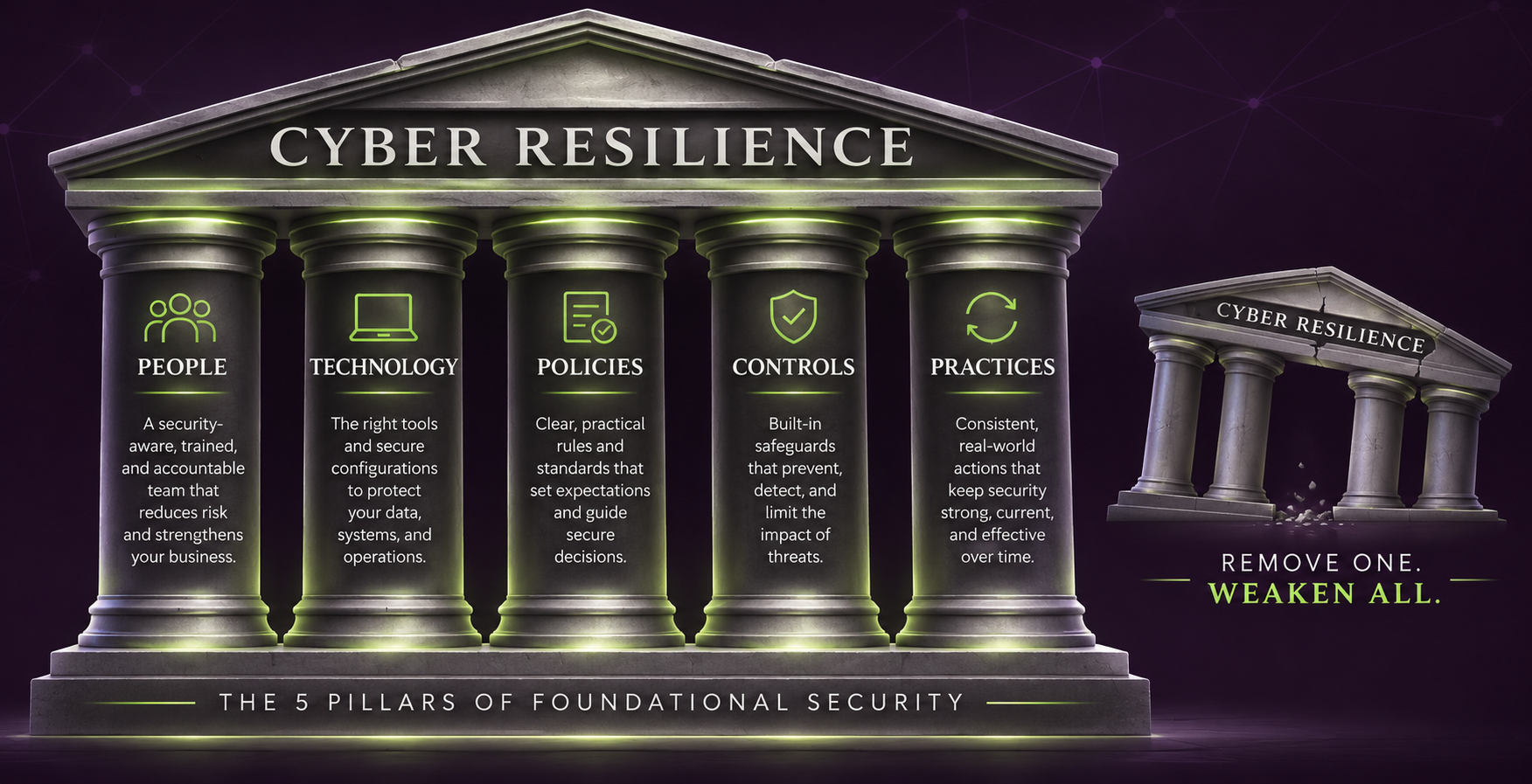
DEFINING THE 5 PILLARS
01 ||||| PEOPLE — Empower your teams
Technology cannot protect an organization without people who understand their role in security. From executives making risk-based decisions to employees recognizing threats, people are the first line of awareness, accountability, and defense.
A strong security culture promotes informed decision-making, clear responsibilities, ongoing education, and shared ownership of security throughout the organization.
02 ||||| TECHNOLOGY — Building the Technical Defense
Technology provides the tools and infrastructure needed to protect business systems, sensitive information, and critical operations.
From identity and access management to endpoint protection, threat detection, encryption, and secure infrastructure, effective technology must be strategically selected, properly configured, continuously monitored, and aligned with actual business risks.
Security isn't about having more tools. It's about making the right tools work together.
03 ||||| POLICIES — Establishing Direction and Accountability
Policies define an organization's security expectations, responsibilities, and requirements. They provide the governance structure needed for consistent decisions, regulatory alignment, and organizational accountability. They establish the standards that guide employees, leadership, technology, and security operations.
Well-designed policies should reflect how a business actually operates—not simply exist as documentation for an audit.
04 ||||| CONTROLS — Turning Security Requirements Into Protection
Controls translate security requirements into measurable safeguards that prevent, detect, and respond to risk.
Whether technical, administrative, or physical, effective controls help enforce security expectations, limit unauthorized activity, protect sensitive assets, and verify that defenses are operating as intended.
Policies define what must happen. Controls help ensure it happens.
05 ||||| PRACTICES — Making Security a Continuous Discipline
Security is not a one-time implementation or annual compliance exercise. It requires consistent action, validation, and improvement.
Day-to-day security practices—including risk assessments, vulnerability management, access reviews, incident response exercises, employee training, and ongoing monitoring—ensure that security remains effective as threats, technologies, and business needs evolve.
A security program is only as strong as the practices that sustain it.
Both People and Technology are the backbone of keeping organizations operational, but if neither is given a set of defined rules to operate within, then how strong is your current foundational pillars? Today are you able to:
Win and maintain new or high-profile customer contracts?
Pass a compliance audit a customer is requiring in a given timeline (usually within 1 year)?
Prevent or recover from a cyber incident or breach?
Avoid reputational or financial losses from lack of security assurances on questionnaires?
Have an endless budget to pay excessive amounts towards maintaining cyber insurance from having minimal security controls/practices?
Maintain complete Risk and Vulnerability Management programs?
Consistent identity management and access reviews to ensure accounts and permissions are accurate?
Rely on customized tools/platforms to ensure incident detection and monitoring is working appropriately?
Trust employees completely from ever being victims of scams and phish attempts?
Assure that previously passing a compliance audit means there are no more security weaknesses?
Develop comprehensive security trainings for both tech and non-tech employees, contractors, software development teams, leadership?
Most Startups and SMBs establish their People and Technology before their Polices, Controls, and Practices, but it does not have to continue this way.
Teams without guidance make inconsistent decisions. Technology without effective controls creates a false sense of protection. Policies without accurate practices become meaningless documents.
That is why it is important to build everything together — Policies establish expectations, Controls implement safeguards, and Practices keep those safeguards functioning for your People and Technology.
True Cybersecurity comes from the strength of all five pillars working together. When executed properly, you will have created a foundation for Cyber Resilience.
Remove One Pillar. Weaken the Entire Foundation.
Psyberology utilizes a blend of hands-on and proprietary innovative, customized, holistic, strategic, and logical approaches to help organizations establish that foundation, identify weaknesses, and build security programs designed for long-term effectiveness — not just perform a set of templated checkbox activities for the next audit, but something sustainable that a business can realistically grow alongside.
Are you ready to schedule a free 30 minute discussion to identify the next steps in how Psyberology can become a valuable partner for your business?
Click the calendar link below to schedule a free meeting!

Meet The Founder & Principal Consultant
Brandi Wolfe is the Founder and operating consultant at Psyberology; with nearly 20 years experience, most of which spent as a vCISO, and a background working across all industries and business sizes.
Brandi’s cybersecurity background began in the US Marine Corps. Afterwards, time was spent in a few industries such as healthcare and criminal justice, including a degree in Psychology, while maintaining active practice in cybersecurity. Soon after, Brandi decided to make her consulting in cybersecurity official by obtaining a degree in Cybersecurity and Forensics.
The consulting methods used by Brandi is a proprietary design that combines various IT and Security roles into a unified consulting strategy. While other vCISOs only focus on strategic planning, Brandi does more across the board, as she cultivated her consulting methodology for companies with little to no Security staff present; which means she can do more with implementation and the true definition of what consulting should become — complete transformations.
Throughout this journey, consistent gaps in how MSPs handle cybersecurity consulting practices began an idea to one day operate independently to help shape the consulting industry into more valuable practices. Since the majority of MSPs offer either consulting or hands-on projects, Brandi has specialized in both in order to bring value to clients by converging multiple IT and Security team roles into one vCISO.
She will not only show you what to do, but also how to implement it using a customized, holistic, and technologically agnostic approach that has been built and tested throughout her years in the consulting industry.

Ready to Chat?
Booking your first appointment is easy and safe. The link will provide a pop-up window for the Psyberology Consulting calendar. Choose the day/time you prefer and you are ready to go!
Notifications — You will receive a reminder the day before and another 30 minutes prior to your scheduled meeting.

Follow On LinkedIn
YouTube Video Library
COMING SOON!